
Like An Inhale
Lessons from Climbing Rocks & Asking Questions

I am tremendously interested in the etymology of words.
And I am equally excited about granting certain words special awards if their origins bring a thrill to my soul, hold some special peculiarity, or are, objectively, simply beautiful.
This week, I learned from a shaggy-haired Australian with a heart as large as the jazzy cat tattoo on his bicep (a tribute to his namesake, Miles Davis) that inspiration deserves one of these awards.
Miles arrived into my life a few days ago with the energy of a younger brother, easygoing and playful, but much like my own brother, unsuspectingly thoughtful. I find the slow reveal of care and depth to be one of the most fascinating parts of my ongoing understanding of manhood. I sit patiently and listen while their characters begin to emerge quietly in more nuanced ways compared to women, who I find generally stare at me straight in the eyes and unveil their entire womanhood within moments.
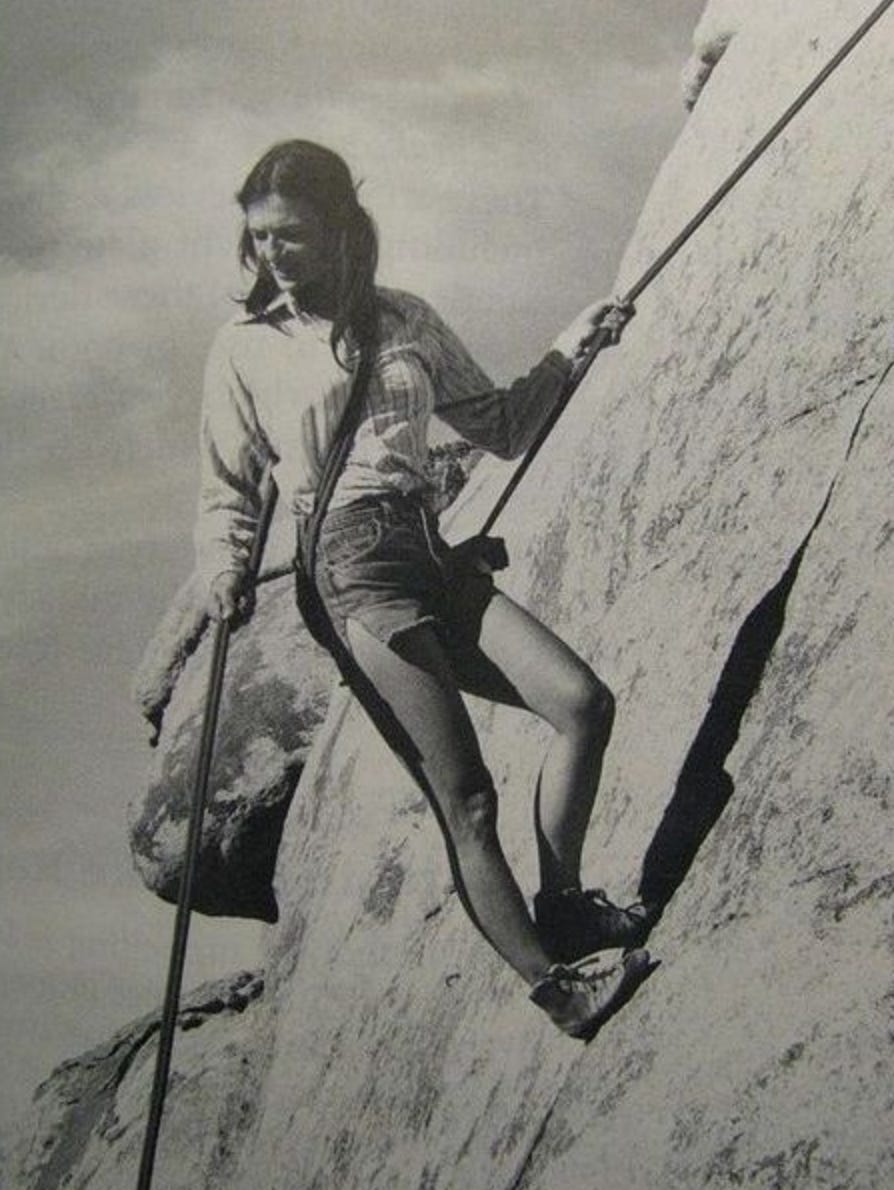
A small group of us were perched on the shore of a rocky cave we had just swum into, in a mountain range, at a sport climbing camp, in the middle of Laos. Taking a midday break from the insane heat, we began reviewing different climbing lingo; tufa (aka. a route covering stalactites), beta (meaning the information needed to complete a route) and anchor (in relation to a secure point of attachment at the top of the route). The lingo is still very fresh to me, and I love contemplating and questioning words with new meanings, in the context of sport. For the first few days, I was convinced everyone was yelling ‘loofah’ as in a body loofah, instead of tufa (quietly trying to figure out what that would possibly have to do with a multipitch climb.) It was similar to when I learned golf and the term loft, as in the angle of the clubface, only registered in my mind as a style of apartment.
As we dried off in the late afternoon sun, a French climbing team began ascending a steep route nearby. We could hear them cheering each other on, their voices bouncing off the stone, punctuated by the sharp honesty of effort, a few “Oh fucks." Somewhere between their echoes, Miles began speaking about his time living in France and about breath.
“To inhale,” he said, almost casually, “is inspirer. From the Latin inspirare; to breathe into.”
It shares its root with inspiration.
At the time, this concept felt interesting. Linguistically satisfying. But not yet award-winning.
Later at dinner, Miles leaned across the table and asked if I find inspiration in people.
“Of course,” I said.
For years I thought I was traveling to find places. But really, I was searching for people. Landing and living in Revelstoke feels like one long inhale. It’s the kind of place where everyone makes me want to celebrate their victories, witness their courage and take life in more fully.
I asked Miles if he found inspiration in people, and he responded, “I’m not really inspired by people. Only guitar players inspire me, they make me want to run home and figure out what they just did.”
And there it was.
What if inspiration was meant to be understood the way the French see it, as an inhale?
Instead of the people around us propelling us outward, we allow them to guide us peacefully to a knowing inward.
I think this starts to feel less like anxiety and urgency and more like space to breathe, a sudden abundance of oxygen around us.
If our lives are spent measuring ourselves against what others are doing, we might just see someone else’s brilliance and assume inspiration means replication. And I feel like that means you miss the magic and instead feel pressure to perform.
But what if inspiration simply means to breathe it all in?
To let a friend’s art, their courage, their existence expand your lungs. To stand with your palms open, to receive.
What a beautiful lesson and I love that the French have led me here, it feels romantic. Sacred.
The award is a result of a new understanding; resist inspiration as just doing and begin to understand it as breath.
Take in every small moment as inspiration. Let it be ordinary and constant and as frequently as you breathe.
omg beautiful!!!
ugh honestly sis I BLEED for ur words. I just finished Osho Aloneness that we were chatting about and learned about
- "monk", linked to the same root as "monopoly" (one power), "monogamy" (one spouse), and "monastery" (a place for those who live alone) …. Aloneness ("All-oneness"): This is a positive, creative, and meditative state where you are filled with your own presence. It is the realization that you are enough, requiring no one else to complete you. It is the "emperor" state of being. Loneliness: This is a negative, miserable state where you feel the absence of another. A lonely person is a "beggar" whose heart is a "begging bowl". In the dictionary, they are the same, but in life, they are polar opposites. Loneliness is a "wound" that needs filling, while aloneness is a "temple" of inner peace.
- similar to your example .. “sin” in French sounds like “sans” which means “without”… Osho often reframed traditional concepts of "sin," defining it not as a moral transgression against a god, but as an act of living inauthentically or ignoring one's own inner, "alone" nature. So to live with sin is to live without finding aloneness with yourself. 🥹