A House Called Memory

I’ve just moved into a new house and my landlord’s name is Memory. Her husband calls her Mem. As if her name is just that; a fragment of Memory.
Since moving into their home, I have been having what I can only really explain to be: episodes of memory lapses.
My friend refers to these typical post travel blues as geo-transitioning; where you may be physically back home, but mentally you are back traveling as if it was the day, you were there.
I am very good at recalling memories and geo-transitioning. I am seamlessly pulled so dramatically back in time; often.
My body continues its steady strides along the familiar path of linear time while my mind slips effortlessly backwards.
Earlier this week, though, the distance between memory and the present disappeared. For the first time, it felt as though my past had finally caught up with me.
It begins in India. It is three o’clock in the afternoon. I’m in the foothills of Rishikesh walking the familiar road in Upper Tapovan from the holistic center, where I had just finished another day of four-hour Ayurvedic treatments. Eastern medicine at its finest; a month of eating only dahl and drinking a concoction of herbal teas that tasted like pickle juice, paired with lymphatic drainage massages and enemas to detoxify the mind, body and spirit. These treatments seemed to be loosening everything except the grief I seemed to still be carrying.
My feet were skimming the dusty road with the heaviness of someone who wasn’t particularly tired but definitely empty. I hummed absentmindedly as I wrapped and rewrapped my pashmina around my shoulders, letting it slip loose again and again. The monkeys watched from their rooftops; the cows stood motionless in their pockets of found shade, too defeated in the heat to continue their wandering.
The afternoon was beginning to turn to monsoon. So was my mind.
Yet there was something so comforting about exploring this range of emotions in a town where everyone seemed to also arrive with an equally heavy, invisible weight.
Every café advertised another version of relief. “Chakra Healing Tonight. Sound Bath Tomorrow. Aura Cleansing the next day. Breathwork, past lives, Akashic records.” It was impossible not to laugh at the marketplace of this sense of hopeful enlightenment, and yet somehow equally impossible not to believe in it. People had travelled halfway across the world to land here with the same hope: that something inside them might finally shift.
I could still feel words lodged somewhere at the base of my throat. All the old ones, unspoken ones; feelings that had been sitting there for so many years, they had begun to feel anatomical.
It was then that a man, who looked remarkably like John Lennon, stepped directly into my path and gently took hold of both of my hands.
I stopped humming.
He looked into my eyes as though we had been in the middle of a conversation.
“You need to pray to a deity to bring music back into your life.”
And before I could answer, he smiled, released my hands, and continued downhill.
It sounds unbelievable now, but in Rishikesh this interaction would barely register as unusual. The strange had a way of becoming ordinary.
By late afternoon the rain arrived.
The tin rooftops were singing louder than the traffic. And instead of retreating to my apartment to lie beneath the ceiling fan and cry, I found myself walking again.
I followed a narrow lane further uphill until, through the curtain of falling water, I noticed a building glowing. Candlelight flickered through large circular windows carved into earthen walls. String lights blurred into golden halos against the rain and from inside came soft music unlike anything I had heard before; ancient, peaceful and almost trance like.
A man with a curled moustache and his long hair tied high into a knot atop his head drifted past one of the windows.
I stepped inside.
For the next six hours we sat side by side in what felt like a pottery studio hidden inside heaven itself. He guided me through the clay creation of the Goddess of Music: Sarasvati. I told him I had a feeling music would find its way back into my life in the form of a trumpet.
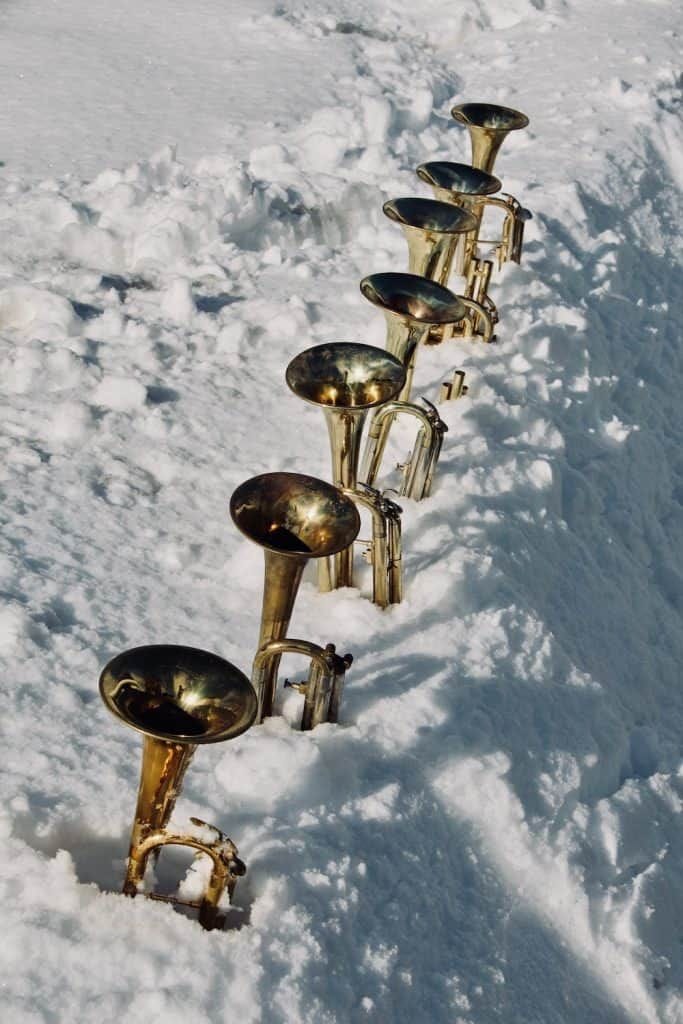
And so, the story ends here, months later, back home, in Revelstoke. I am sat on a beamingly sunny afternoon in my garden facetiming my mom when all of a sudden, a ray of light hits Memory’s balcony above; and there it is. Sitting outside of its case, practically lifting itself off the shelf with a trail of music notes painting the sky in its wake - the trumpet.
“I’ll call you back Mom.” I say, as I run up to Memory.
She tells me the woman who lived here before her was a professional trumpet player.
“You should have it,” she says.
As I take hold of it, another memory arrives before the one from India.
I’m ten years old, standing in my elementary school music room with my first trumpet in my hands.
I hadn’t thought about that little girl in years.
And maybe that is what memory really does. It doesn’t preserve the past; it safeguards the parts of ourselves we’ve left behind until we’re ready to meet them again.
We spend so much of our lives believing we’re becoming someone new, but what if we’re simply being reintroduced to everyone, we’ve already been.